


The design and long-term performance of road pavements are highly dependent on the mechanical properties of the underlying subgrade soils. Accurate characterization of soil stiffness, stress history, deformability, and in-situ stress conditions is therefore essential for ensuring adequate pavement serviceability and minimizing maintenance costs. Traditionally, pavement investigations have relied on laboratory testing, California Bearing Ratio (CBR) measurements, plate load tests, and Cone Penetration Tests (CPT). However, these methods often provide limited information regarding the in-situ stress–strain behavior of soils under working load conditions.
In pavement engineering, DMT offers several advantages over conventional investigation methods. The test provides continuous profiling of subgrade stiffness and constrained modulus, enabling a more reliable evaluation of settlement and deformation under traffic loading. The DMT-derived constrained modulus (M) has been shown to correlate well with the deformation behavior of pavement foundations and can be used for estimating elastic settlements and assessing the need for ground improvement measures.
Borden (1986), based on laboratory work on A-2-4 to A-7-5 soils, tentatively suggested to estimate CBR % (corrected, unsoaked) as a function of ED:
Prof. Marchetti (1994) describes the use of DMT as a fast acceptance tool for the subgrade compaction in a road in Bangladesh. The procedure was the following:
The acceptance MDMT profile could then be used as an economical production method for quality control of the compaction, with only occasional verifications by the originally specified methods (Proctor, laboratory/in situ CBR and plate load tests).
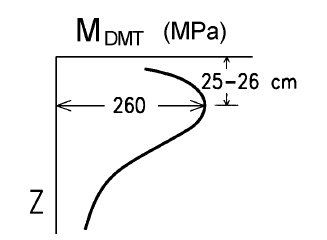
Interestingly, all the after-compaction MDMT profiles had the typical shape of the profile shown in Figure, with the maximum MDMT found almost invariably at shallow depths.
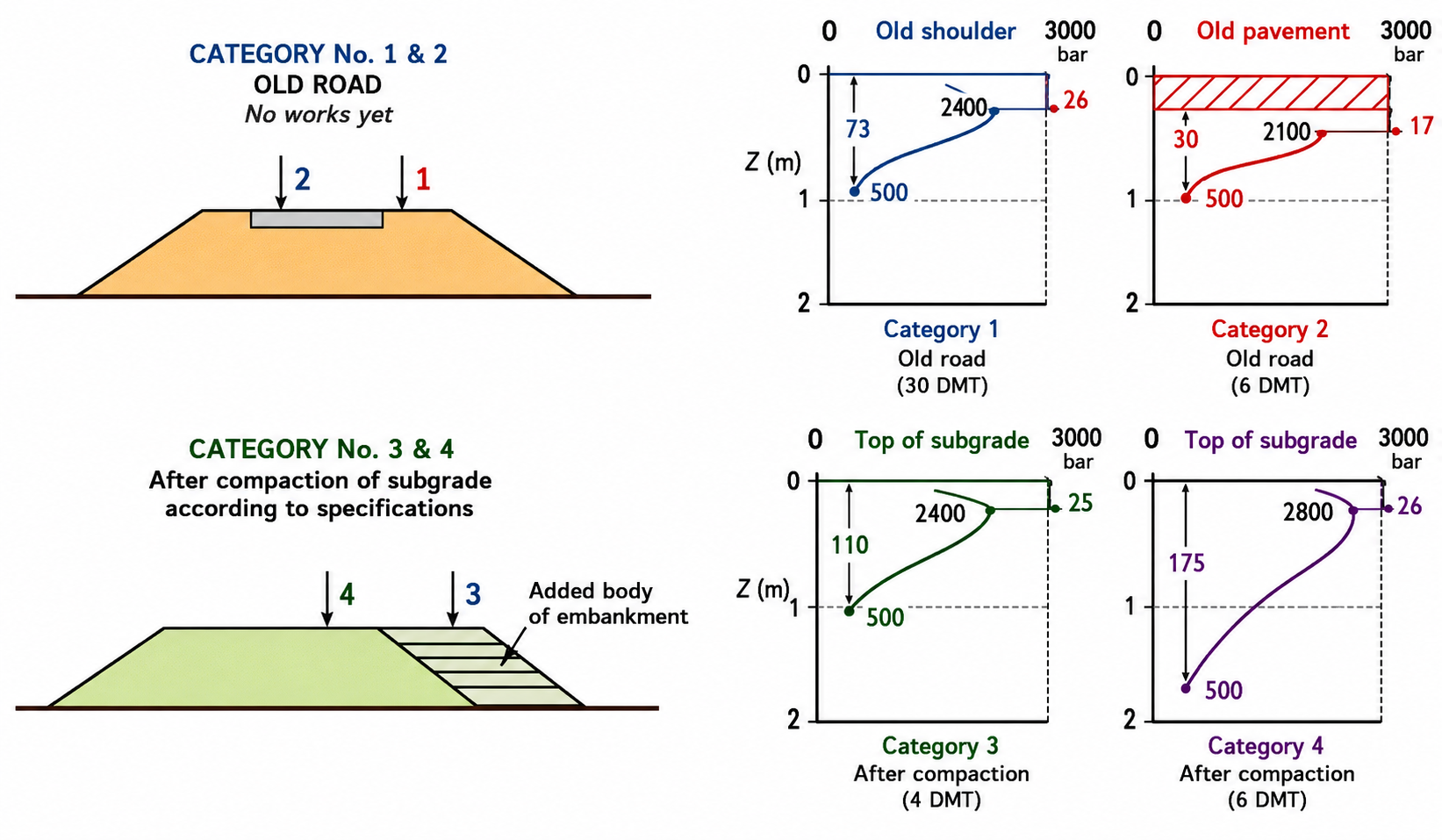
It can be noted that many of today’s methods of pavement design make use of moduli rather than other indirect parameters. Hence, the availability of the MDMT profiles may be of some usefulness to evaluate the subgrade compaction of the pavements.